Picture a typical day on your sales floor. Every agent is logged in, headsets on, and screens full of contact lists. By 6 PM, everyone looks exhausted. And yet, when you check the call logs, the actual number of conversations doesn’t match the hours put in. Sound familiar? If you’ve ever wondered why a busy team isn’t producing the pipeline you expect, you’re not alone, and it’s usually one of the most common manual calling problems hiding in plain sight. This is exactly where a good auto dialer for sales teams in Dubai starts to make a real difference, because it targets the gap between “working” and “actually talking to prospects”.

Here’s the thing: busy doesn’t always mean productive. Your agents might be spending time on tasks that feel like work but don’t move a single deal forward, like:
- Searching for the next contact to call
- Manually typing or copy-pasting phone numbers
- Waiting for calls to connect
- Listening to endless ringing
- Handling busy signals
- Sitting through voicemail greetings
- Updating records after every call
- Switching between different systems and tabs
- Deciding, call after call, who to dial next
None of that is “laziness”. It’s just friction. And friction adds up fast across a full workday.
The real issue usually isn’t that your agents aren’t working hard enough. It’s that the calling process itself is inefficient. That’s exactly why so many outbound teams eventually look into a dialer solution in Dubai, not to replace their agents, but to remove the repetitive, non-selling tasks that quietly eat into their day.
How Much of an Agent’s Day Is Actually Spent Talking?
This is the question most sales managers never ask, and it’s the one that matters most.
There’s a big difference between:
Working time ≠ Dialing time ≠ Productive conversation time
An agent can be logged in for eight hours, technically “working” the entire shift. But dialling time – the time spent actually placing calls – is usually much smaller. And productive conversation time, where an agent is genuinely speaking with a prospect, is smaller still.
Think about it this way: between each call, an agent might spend a few minutes selecting the next contact, dialling the number, and waiting for it to connect (or not connect at all). On its own, that seems minor. But multiply those few minutes by dozens or hundreds of calls a day, and the gap becomes significant.
We won’t throw around a specific number like “agents waste exactly 40% of their time”, because that kind of claim needs solid, case-specific data to back it up. What we can say is that this productivity leakage is real, and it’s one of the most persistent outbound calling challenges sales leaders deal with – small delays, repeated constantly, that quietly reduce the number of conversations your team could be having.
7 Hidden Reasons Your Agents Aren’t Making Enough Calls
If you’re trying to figure out why call volume is lower than it should be, these are usually the culprits.
1. Manual number dialing takes time
Agents repeatedly type in phone numbers instead of moving straight to the next contact. It seems small, but it interrupts momentum on every single call.
2. Agents spend time on unanswered calls
Ringing, busy tones, and voicemail all consume time without producing a conversation. None of it counts toward actual selling.
3. Finding the next lead is inefficient
Without a structured system, agents may need to dig through spreadsheets, CRM records, or separate lead lists just to figure out who to call next.
4. Follow-ups are handled manually
When follow-up depends entirely on an individual agent remembering to do it, important leads can slip through the cracks or get delayed.
5. Agents switch between multiple systems
Bouncing between a CRM, a contact list, and a separate phone application creates constant, unnecessary interruptions in the workflow.
6. Growing lead lists increase the workload
More leads sound like a good problem to have until the team can’t actually reach them fast enough. A bigger list doesn’t automatically mean more sales.
7. Hiring more agents isn’t always the right first move
It’s tempting to solve a low call-volume problem by adding headcount. But before you do, it’s worth examining whether the existing calling process itself is the bottleneck. Sometimes the fix isn’t more people; it’s a smarter process.
Interestingly, this ties into a broader pattern in sales research: teams that focus on removing friction from their process tend to see stronger results than teams that simply add more activity. HubSpot’s ongoing sales research has tracked similar patterns around how reps spend their day, and the takeaway is consistent: reducing non-selling tasks tends to matter more than just pushing agents to “try harder”.
What Is an Auto Dialer and How Does It Solve This Problem?
In simple terms, an auto dialer automates parts of the outbound calling process so agents don’t have to manually perform every single dialling step themselves.
The basic workflow looks something like this:
Lead list → Dialing → Call connection → Agent conversation → Call outcome → Next lead
Instead of an agent manually picking a contact, typing the number, and waiting through the connection process, the system handles the repetitive parts. This is the core reason so many outbound teams start searching for an auto dialer system Dubai businesses can rely on — it directly addresses the friction we described earlier, without changing what your agents are actually good at: having conversations.
Which Auto Dialer Is Right for Your Business?
Not every outbound operation works the same way, which is why there isn’t a single “one-size-fits-all” answer. Here’s a breakdown of the main options.
Power Dialer
A Power Dialer automatically moves through a list of contacts and initiates the next call based on how the system is configured.
Best suited for:
- Sales teams
- Lead-generation campaigns
- Outbound sales
- Telemarketing teams
- Businesses with large prospect lists
Problem it solves: Agents don’t need to manually select and dial every number themselves. If you’re specifically comparing options, our Power Dialer software solution in Dubai is built around this exact use case for teams that need consistent, high-volume outbound calling.
Progressive Dialer
A Progressive Dialer takes a more controlled approach; it dials the next contact only when an agent is ready and available, depending on how the system is set up.
Best suited for:
- Sales teams that need controlled calling
- Customer follow-ups
- Lead qualification
- Campaigns where agent availability matters
Problem it solves: It helps coordinate calling activity with actual agent availability instead of leaving every call to be manually initiated one at a time.
Agentless Dialer
An agentless dialer system in Dubai can automate certain outbound campaigns without needing a live agent on every single call.
Potential use cases:
- Notifications
- Reminders
- Announcements
- Campaign messages
- Automated outbound communication
Problem it solves: Businesses don’t need to tie up an agent for every repetitive outbound message. That said, it’s worth being clear here — an agentless dialer isn’t meant to replace your sales agents when a campaign genuinely requires a human conversation. It’s a tool for a different type of communication need.
Manual Calling vs Auto Dialer
Sometimes a side-by-side comparison makes the difference obvious.
| Manual Calling | Auto Dialer |
| The agent manually enters numbers | The system automates dialing |
| The agent selects next contact | Contacts can be processed systematically |
| More repetitive work | Less repetitive dialing |
| Difficult to scale manually | Easier to handle larger call volumes |
| Follow-ups may depend on agents | Can support structured workflows |
| Productivity varies by agent | More consistent calling process |
It’s important to be honest about what this technology can and can’t do. An autodialer doesn’t automatically guarantee more sales. What it does is improve the calling process itself and support better sales agent productivity. Actual results still depend on lead quality, your offer, the sales script, individual agent skill, and consistent follow-up. A tool can only do so much; the rest is still down to your team and your strategy.
Signs Your Business Is Ready for an Auto Dialer
Not sure whether this applies to you? Ask yourself:
- Do your agents manually dial every number?
- Are agents spending significant time between calls?
- Does your team handle hundreds of outbound leads?
- Are follow-ups being missed?
- Is your lead database growing faster than your calling capacity?
- Are you considering hiring additional agents just to increase call volume?
- Do managers struggle to monitor outbound calling activity?
- Are agents spending too much time on non-productive dialing tasks?
If several of these sound familiar, it may genuinely be time to evaluate an auto dialer for sales teams in Dubai as part of your setup.
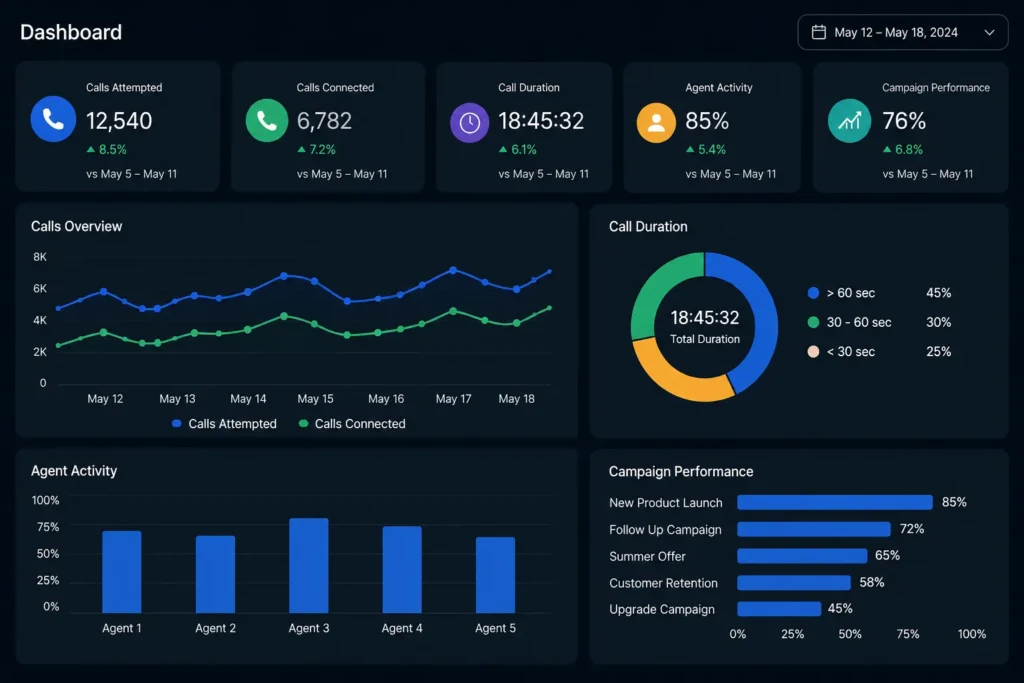
How to Choose the Right Auto Dialer Solution in Dubai
Once you’ve decided it’s worth exploring, here’s what actually matters when comparing options.
- Call volume – How many outbound calls does your team realistically make each day?
- Agent workflow – Do your agents need controlled, paced calling or continuous outbound dialing?
- Campaign type – Sales, lead generation, reminders, and automated notifications often call for different approaches.
- CRM integration – If your team already relies on a CRM, integration can cut down on repetitive data entry.
- Reporting – Look for useful metrics, such as:
- Calls attempted
- Calls connected
- Call duration
- Agent activity
- Campaign performance
- Scalability – The system should be able to grow alongside your business as call volume and headcount increase.
Many teams also pair their calling setup with an IVR Solution Dubai businesses use to route inbound calls efficiently, since inbound and outbound workflows often need to work together rather than in isolation.
How an Auto Dialer Can Improve Sales Calling Efficiency
It’s easy to oversimplify this and just say, “More calls equal more sales.” That’s not quite accurate, and it’s not a very convincing argument either. Here’s the more realistic chain of events:
Less manual dialing → less idle time → more efficient call workflow → more calling opportunities → better lead follow-up → potential increase in sales opportunities
Notice the word “potential”. A well-chosen sales dialer Dubai teams use can absolutely create more room for conversations to happen. Whether those conversations convert still comes down to everything else in your sales process.
When an Auto Dialer Is NOT the Solution
This section matters because it’s easy to oversell technology as a cure-all. It isn’t.
An autodialer won’t fix:
- Poor-quality leads
- Weak sales scripts
- Poor agent training
- Bad offers
- Incorrect customer targeting
- Lack of a follow-up strategy
The technology addresses calling-process inefficiency, not every sales problem you might be facing. If your challenges sit somewhere else in the funnel, a dialer alone won’t solve them, and it’s worth diagnosing the real bottleneck before investing in new tools.
Why Dubai Businesses Use Dialer Solutions for Outbound Calling
Dubai’s business landscape includes a lot of industries that rely heavily on outbound calling to generate and manage leads, including:
- Real estate
- Insurance
- Financial services
- Recruitment
- Education
- Travel
- BPO and call centers
- Telemarketing
- Lead-generation companies
The common thread across all of these industries is the same: high-volume outbound calling requires an efficient calling workflow to actually work. That doesn’t mean every single business in Dubai needs an auto dialer; it depends entirely on call volume, team size, and how the sales process is structured. But for businesses already dealing with large lead lists and outbound-heavy sales models, a power dialer for sales teams is often one of the more practical upgrades available.
It’s also worth noting that reliable calling infrastructure doesn’t exist in a vacuum — it depends on solid IT foundations too. Businesses that invest in dependable IT AMC Dubai coverage or ongoing IT Support Services in Dubai tend to have fewer disruptions when running dialer systems and CRM integrations at scale, since technical downtime can undo a lot of the efficiency gains a dialer is meant to provide.
Turn Your Calling Time Into Productive Conversations
If your sales agents are spending more time dialing, waiting, and searching for leads than actually speaking with prospects, your calling process may be the thing holding your team back — not your agents themselves.
Our dialer solution in Dubai includes Power Dialer, Progressive Dialer, and Agentless Dialer options, each designed for different outbound calling needs. Whether you’re running a large-scale sales operation or a smaller, more targeted follow-up campaign, there’s usually a configuration that fits.
Talk to our dialer solution team in Dubai to walk through your call volume, workflow, and business requirements – and find the right dialer for your outbound sales team.
FAQ
It’s a system that automates parts of the outbound calling process – like dialing numbers and moving to the next contact – so agents spend less time on repetitive manual tasks and more time in actual conversations.
By removing repetitive tasks like manual dialing, searching for contacts, and handling unanswered calls, agents can spend more of their time on productive conversations instead of administrative dialing work.
A Power Dialer moves through a contact list automatically based on the configured workflow, while a Progressive Dialer dials the next contact based on agent availability, offering a more controlled pace.
An agentless dialer works well for automated communication like reminders, notifications, and announcements — not for campaigns that require a live sales conversation.
It can be, depending on call volume and workflow needs. Smaller teams with high outbound activity may still benefit, even if their overall headcount is limited.
Consider your daily call volume, the type of campaigns you run, whether you need CRM integration, what reporting metrics matter to you, and how well the system can scale as your business grows.
No. It improves the calling process and agent efficiency, but actual sales results still depend on lead quality, your offer, the sales script, and how well agents follow up.
Many dialer systems are built to integrate with popular CRMs, which helps reduce repetitive manual data entry and keeps call records organized automatically.
Industries with high outbound call volumes — such as real estate, insurance, financial services, recruitment, and BPOs — tend to rely on dialer systems the most.
Useful metrics include calls attempted, calls connected, call duration, individual agent activity, and overall campaign performance.