If your team spends half the day scrolling through a spreadsheet, punching in numbers, and waiting for someone to pick up, you already know how much time gets wasted before a single real conversation starts. That’s exactly the gap a Progressive Dialer Platform Dubai businesses are increasingly switching to helps close. Whether you’re running a small sales desk or a full call centre floor, the right dialler changes how many people your agents actually talk to in a day and how good those conversations turn out to be.
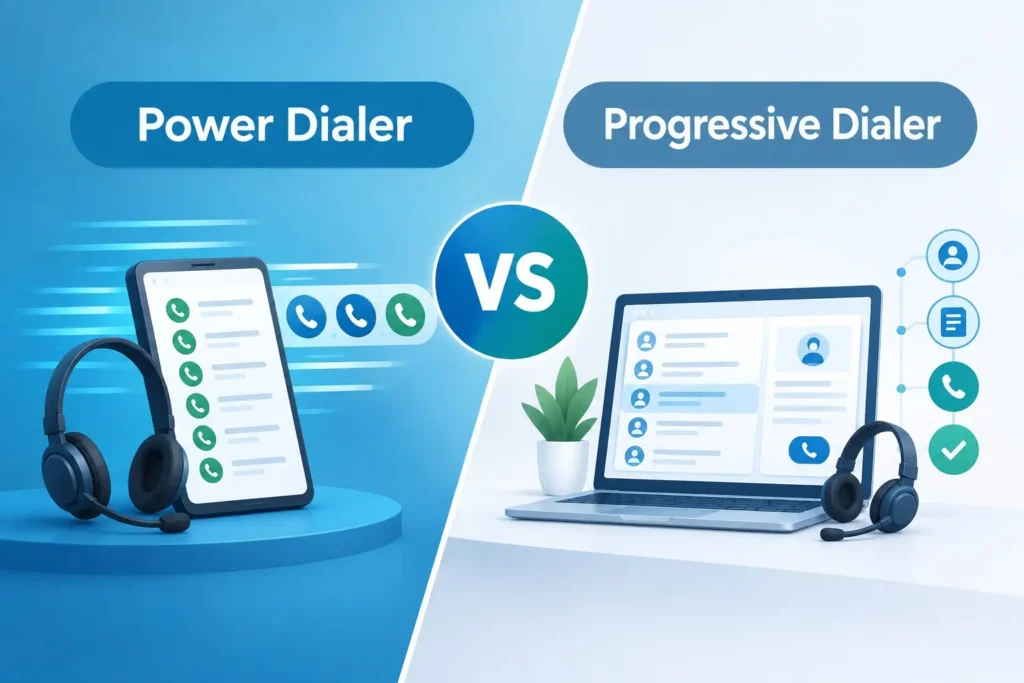
But here’s the catch: not every dialer works the same way, and picking the wrong one can quietly hurt your results. Two of the most common options businesses compare are the power dialer and the progressive dialer. They sound similar, get lumped together in vendor pitches all the time, and yet they solve fairly different problems.
- Power Dialer — focuses on calling leads quickly, typically moving to the next contact right after each call wraps up.
- Progressive Dialer — gives the agent a little breathing room and context before the next call goes out, so they’re not walking into a conversation blind.
So which one actually fits your business? Honestly, it depends on your calling volume, your sales process, how your agents like to work, and how much control you want your team to have over the pace of the day. Let’s break it down properly.
What Is a Power Dialer?
A power dialer is built for speed. Think of it as your outbound engine,it takes a contact list and works through it automatically, calling one number after another with barely a pause in between.
Here’s what it typically does well:
- Automatically dials numbers from a contact list, no manual punching required.
- Moves through the list quickly, one call after the next.
- Cuts down on manual number entry and the small errors that come with it.
- Works especially well for teams handling high-volume outbound calls.
- Helps improve overall agent calling efficiency, since less time is wasted between calls.
If your team lives and breathes cold calling, think large lead lists, tight scripts, and a “more calls, more conversations” mindset; a power dialer usually earns its place fast.
How Does a Power Dialer Work?
The flow is pretty simple, and that’s part of the appeal:
Lead List → Dial Number → Agent Handles Call → Call Ends → Next Number
There’s no real pause built in. As soon as one call wraps up, the system is already moving on to the next contact. It’s efficient, but it does mean agents have less time to prepare between calls.
If you want to see how this looks in a real deployment, our Power Dialer software solution in Dubai page walks through how it’s typically set up for outbound teams here.
What Is a Progressive Dialer?
A progressive dialer takes a slightly different approach. Instead of racing through the list, it controls the pace of outbound calling based on agent availability. Rather than continuously dialing contacts at high speed, it gives the agent a moment to actually prepare before connecting to the next lead.
This is really the heart of what a Progressive Dialer Platform Dubai teams are adopting is designed to do, it doesn’t try to out-dial the competition on raw speed. Instead, it tries to make every single call count a bit more.
How Does a Progressive Dialer Work?
The flow looks a little different here:
Lead Selected → Agent Gets Lead Information → Number Is Dialed → Agent Handles Call → Next Lead
Notice the extra step “Agent Gets Lead Information” sitting right before the number is even dialed. That small window is where a progressive dialer earns its reputation for better-quality conversations. Agents walk in knowing who they’re calling and why, rather than reacting on the fly.
If you’re weighing this option for your own outbound team, our dedicated Progressive Dialer page breaks down the setup and features in more depth.
Power vs Progressive Dialer: Key Differences
Here’s where things get concrete. Neither dialer is universally “better”, they’re just built around different priorities. Take a look at how they stack up side by side.
| Feature | Power Dialer | Progressive Dialer |
| Calling speed | High | Controlled |
| Manual dialing | Reduced | Reduced |
| Agent preparation | Limited | More time to prepare |
| Calling volume | Suitable for high volume | Suitable for structured calling |
| Agent control | Moderate | Higher |
| Lead context | Depends on system | Usually available before calling |
| Best suited for | High-volume outbound teams | Sales teams needing more preparation |
| Calling approach | Speed-focused | Agent-focused |
This is really the crux of the power vs progressive dialer debate, one leans into raw volume, the other leans into control and preparation. Neither is wrong; they’re just tools for different jobs.
Power Dialer vs Progressive Dialer for Dubai Businesses
Dubai’s business landscape is a mix of everything, high-volume telesales floors, boutique consultative sales teams, real estate outreach, financial services, and everything in between. So the “right” dialer really comes down to what your team actually does all day.
Choose a Power Dialer When:
- Your team makes a large number of outbound calls every single day.
- Speed is a core part of your workflow, not a nice-to-have.
- Agents follow a fairly standardised calling script.
- You want to cut down on time spent manually dialing numbers.
A power dialer Dubai teams in high-volume industries, think collections, telemarketing, or appointment-setting, tend to gravitate toward this setup because it maximises the sheer number of conversations agents can have.
Consider a Progressive Dialer When:
- Agents need to review lead information before picking up the phone.
- Calls require a more personalised, less scripted conversation.
- Your sales team follows a consultative sales process.
- Lead quality matters more to you than raw call volume.
If any of that sounds like your setup, a progressive dialer Dubai businesses are choosing more often lately might be the better long-term fit, especially in sectors where trust and relationship-building matter more than speed.
Which Dialer Is Better for Sales Teams?
There’s no universal winner here, and honestly, any article that tells you otherwise is probably oversimplifying things. It really comes down to matching the tool to the workflow:
- High-volume prospecting → Power Dialer
- Personalised lead follow-up → Progressive Dialer
- Structured sales campaigns → Either, depending on your specific workflow
- Complex lead conversations → A progressive dialer may give agents more room to prepare
This is a more useful way to think about it than chasing a generic “X is better than Y” answer, because the truth is both tools are excellent, just for different kinds of calling.
Power vs Progressive Dialer: Agent Productivity
Regardless of which one you pick, both dialer types are built to lighten the load on your agents. Here’s what generally improves once you move away from manual dialing:
- Reduced manual dialing, which means fewer wasted minutes per hour.
- Less idle time between calls.
- Better lead-list management overall.
- More room for agent preparation (particularly with progressive dialing).
- More consistent outbound campaigns across the team.
- Generally more organised calling workflows day to day.
Worth noting: exact productivity gains vary a lot depending on your team size, lead quality, and how well the system is configured, so treat any specific percentage claims you see online with a healthy dose of scepticism unless they come with real data behind them.

CRM Integration and Lead Management
A dialer on its own is useful. A dialer connected to your CRM is a completely different level of useful. When your progressive dialer software or power dialer platform talks directly to your CRM, your team gets a much smoother workflow overall.
Here’s what good CRM integration typically unlocks:
- Instant access to lead information right when a call connects.
- Automatic tracking of call outcomes; no manual logging required.
- Easy updates to lead status as conversations progress.
- Better management of follow-ups, so nothing slips through the cracks.
- A complete call history for every contact.
- More organised sales campaigns overall, since everything lives in one place.
Businesses looking at an outbound dialer solution in Dubai often find that the CRM integration piece ends up mattering just as much as the dialing mode itself, it’s the difference between a tool that just makes calls and one that actually helps you close deals.
What to Look for in a Dialer Platform in Dubai
If you’re shopping around, it helps to have a checklist rather than just comparing price tags. Here’s what actually matters when you’re evaluating a dialer solution in Dubai:
- CRM integration
- Call recording
- Campaign management
- Agent monitoring
- Call reports and analytics
- Lead management
- Scalable architecture
- Reliable technical support
- Flexible dialing modes
- Security and access controls
A platform that checks most of these boxes will usually serve you well whether you end up going with power dialing, progressive dialing, or a mix of both depending on the campaign. And if reliability and uptime are a concern, which they should be for any tool your sales floor depends on daily, it’s worth pairing your dialer setup with dependable IT AMC Service in Dubai to keep everything running smoothly behind the scenes.
Power vs Progressive Dialer: Which One Should You Choose?
Rather than crowning a single winner, it’s more useful to think of this as a decision guide based on what your business actually needs right now.
Choose a Power Dialer if your priority is:
- Faster outbound calling
- High calling volume
- Simple, repeatable sales campaigns
- Efficient list dialing without a lot of manual steps
Choose a Progressive Dialer if your priority is:
- Agent preparation before every call
- Personalised conversations
- Controlled, steady calling pace
- Better lead context going into each call
Key takeaway: the “winner” here really depends on your business workflow, not simply on which dialer moves faster. A high-speed dialer that overwhelms your agents with unqualified calls isn’t actually winning anything, and a slower, more controlled dialer that leaves your team under capacity isn’t either. If you want a deeper technical breakdown of how the two compare on pacing and connection quality, this comparison from CloudTalk is a solid outside read.
Get the Right Dialer Solution for Your Dubai Business
Whichever direction you’re leaning, the goal is the same: fewer wasted minutes, more real conversations, and a calling workflow your agents don’t dread. We provide a range of dialer solution in Dubai options, including power, progressive, and agentless dialing, configured around what your business actually needs rather than a one-size-fits-all setup.
For teams that also run a broader call center operation, it’s worth looking at how your dialer fits into your wider call center solution Dubai setup, since dialing is just one piece of the puzzle. And if your systems need ongoing maintenance or troubleshooting support, pairing your dialer rollout with solid IT Support Services in Dubai will save you a lot of headaches down the line.
Looking for a Dialer Solution in Dubai? Talk to our team to discuss your outbound calling requirements and find a dialer setup that genuinely fits your sales or call-center workflow — no generic recommendations, just what actually works for your business.
FAQ
A power dialer moves to the next number almost immediately after a call ends, prioritizing speed. A progressive dialer gives agents a short window to review lead details before the next call connects, prioritizing preparation and control.
A power dialer is generally better suited for high-volume outbound calling since it’s built to minimize downtime between calls and maximize the number of contacts reached per hour.
Yes, typically. Because agents get lead context before the call connects, a progressive dialer usually works better for consultative sales or conversations that need more personalization.
Yes. Both power and progressive dialers automate the number-dialing process, which removes the need for agents to manually look up and dial each contact.
In most cases, yes. A well-built progressive dialer platform is designed to connect with common CRM systems so agents can access lead data, track outcomes, and manage follow-ups from one place.
Progressive dialers tend to be a bit friendlier for newer agents since there’s more time to review information before each call, reducing the pressure compared to a fast-paced power dialer setup.
Yes. Both power and progressive dialer solutions can scale, though the right fit often depends on team size, lead volume, and how structured your sales process is.
Sectors like finance, real estate, insurance, and consultative B2B sales often lean toward progressive dialer software because of the added preparation time and compliance-friendly pacing.
Pricing usually depends more on the platform, features, and number of seats than on the dialing mode itself, so it’s worth comparing full packages rather than assuming one mode is inherently cheaper.
Start with your calling goals: if speed and volume matter most, lean power. If lead quality, preparation, and personalization matter more, lean progressive. Many businesses even end up using both, depending on the specific campaign.